


Table of Contents
- 1 What the Family Reunification Procedure Is
- 2 Why a Marriage Certificate Isn’t Enough
- 3 What Gets Checked for the Israeli Citizen
- 4 What Gets Checked for the Foreign Spouse
- 5 Why the Couple’s Relationship History Matters
- 6 When Interviews May Be Scheduled in Two Countries at Once
- 7 How the Family Reunification Procedure Works
- 8 How Long the Procedure Takes
- 9 How to Reduce the Risk of Delays
- 10 FAQ
- 10.1 Can status be granted based on a marriage certificate alone?
- 10.2 Do the couple have to be formally married?
- 10.3 What happens if the foreign spouse has gone through this procedure before?
- 10.4 Can past entry issues with Israel affect the case?
- 10.5 How long does the family reunification procedure take?
- 10.6 Is interview preparation necessary?
- 11 In Short
When an Israeli citizen builds a family with a foreign national, the couple must go through a family reunification procedure in order to live together in Israel. It involves submitting documents, undergoing background checks, attending interviews, and progressing through a series of temporary statuses that can ultimately lead to Israeli citizenship.
Below, we break down how this procedure works, what the Israeli Ministry of Interior looks into, when the process becomes more complicated, and how long it can take.
What the Family Reunification Procedure Is
The family reunification procedure is a framework set by Israel’s Ministry of Interior that allows an Israeli citizen to obtain legal status in Israel for a foreign spouse.
In essence, it’s a roadmap for legalizing a foreign partner’s status: first, the person is granted permission to reside and work in the country legally, then a temporary residence permit, and finally, after completing the full process, they may qualify for permanent residency or citizenship.
The procedure isn’t limited to formally registered marriages. Under certain circumstances, it can also apply to couples in a common-law partnership. For example, this may come into play when an Israeli citizen is going through a lengthy divorce and is not yet formally able to register a new marriage.
Under a favorable scenario, the entire process — from start to citizenship — can take about five years. However, the actual timeline depends on the specific circumstances of each family and any factors that call for additional scrutiny.
Why a Marriage Certificate Isn’t Enough
A registered marriage on its own does not automatically entitle a foreign spouse to status in Israel.
The Ministry of Interior looks beyond the marriage certificate — it also examines both partners’ personal circumstances, documentation, and whether the relationship is genuine.
The foreign spouse may be asked to provide documents relating to:
- birth;
- marital status;
- prior marriages;
- any intermediate immigration status held;
- absence of a criminal record;
- residence in other countries.
If a person has lived for extended periods outside their home country, additional documents from those other countries may be required as well — for instance, proof of no legal issues in a country of prior residence.
The exact set of required documents depends on each person’s individual background. There is no universal checklist that applies equally to every family.
In addition, the couple must provide evidence that the relationship is genuine: joint photos, travel tickets, trip documentation, a written account of how the relationship began and developed, and letters from relatives or friends who can vouch for the couple.
What Gets Checked for the Israeli Citizen
The Ministry of Interior examines not only the foreign spouse but also the background of the Israeli partner.
Additional questions may arise, for example, if the Israeli citizen has previously gone through the family reunification procedure with a different foreign spouse.
The system may also flag:
- issues with the person’s current marital status;
- an unfinalized divorce;
- ongoing criminal proceedings;
- circumstances surrounding previous relationships;
- bankruptcy;
- prior procedures to legalize a foreign partner’s status.
The Israeli citizen’s “center of life” is also reviewed. This may require documents proving residence in the country, employment, income, banking activity, and social integration.
What Gets Checked for the Foreign Spouse
The Ministry separately reviews the foreign spouse’s background.
Particular scrutiny may apply if the person:
- has previously gone through the family reunification procedure with a different Israeli citizen;
- was previously denied entry into Israel;
- was previously in the country under a different immigration process;
- applied for political asylum;
- has close relatives who are permanent residents of Israel.
None of these circumstances automatically results in a denial. However, they may trigger a more thorough review.
For example, if a person began the family reunification procedure with a different partner years earlier, obtained a temporary status, and the relationship later ended — closing that case — this history will be visible to the Ministry when a new application is filed.
The same applies to a prior lengthy stay in Israel under an asylum process.
Why the Couple’s Relationship History Matters
One of the documents a couple submits is a written account of their relationship history. This may seem like a minor part of the application, but a poorly written narrative can raise additional questions.
The account shouldn’t be turned into an overly detailed chronicle packed with irrelevant minutiae. The more incidental dates, episodes, and small details included, the greater the chance of internal inconsistencies.
At the same time, a description reduced to a few formal lines may not be sufficient either. The account needs to clearly and coherently explain how the couple met, how the relationship developed, and why they decided to build a life together.
What matters most is that the content matches the real facts and the other evidence submitted.
When Interviews May Be Scheduled in Two Countries at Once
Under a typical scenario, the procedure moves through document review followed by in-person meetings at the Ministry of Interior. However, if questions arise about either partner’s background or about the relationship itself, a more complex interview process may be scheduled.
In that case, the Israeli citizen is interviewed in Israel, while the foreign spouse is interviewed at the Israeli mission in their country of residence. This type of review is more demanding than a standard interview because the spouses are questioned by different officials, and their answers are later compared. Discrepancies can arise even without any intent to deceive — simply due to natural differences in how people recall events, translation nuances, or how answers get recorded.
Language plays a particularly important role here. In Israel, the applicant or their representative can monitor the accuracy of translation and record-keeping. During an interview abroad, however, the conversation may take place in Russian while being recorded in Hebrew, making it harder to verify accuracy. That’s why thorough preparation and a solid grasp of the couple’s actual relationship history are essential ahead of such an interview.
How the Family Reunification Procedure Works
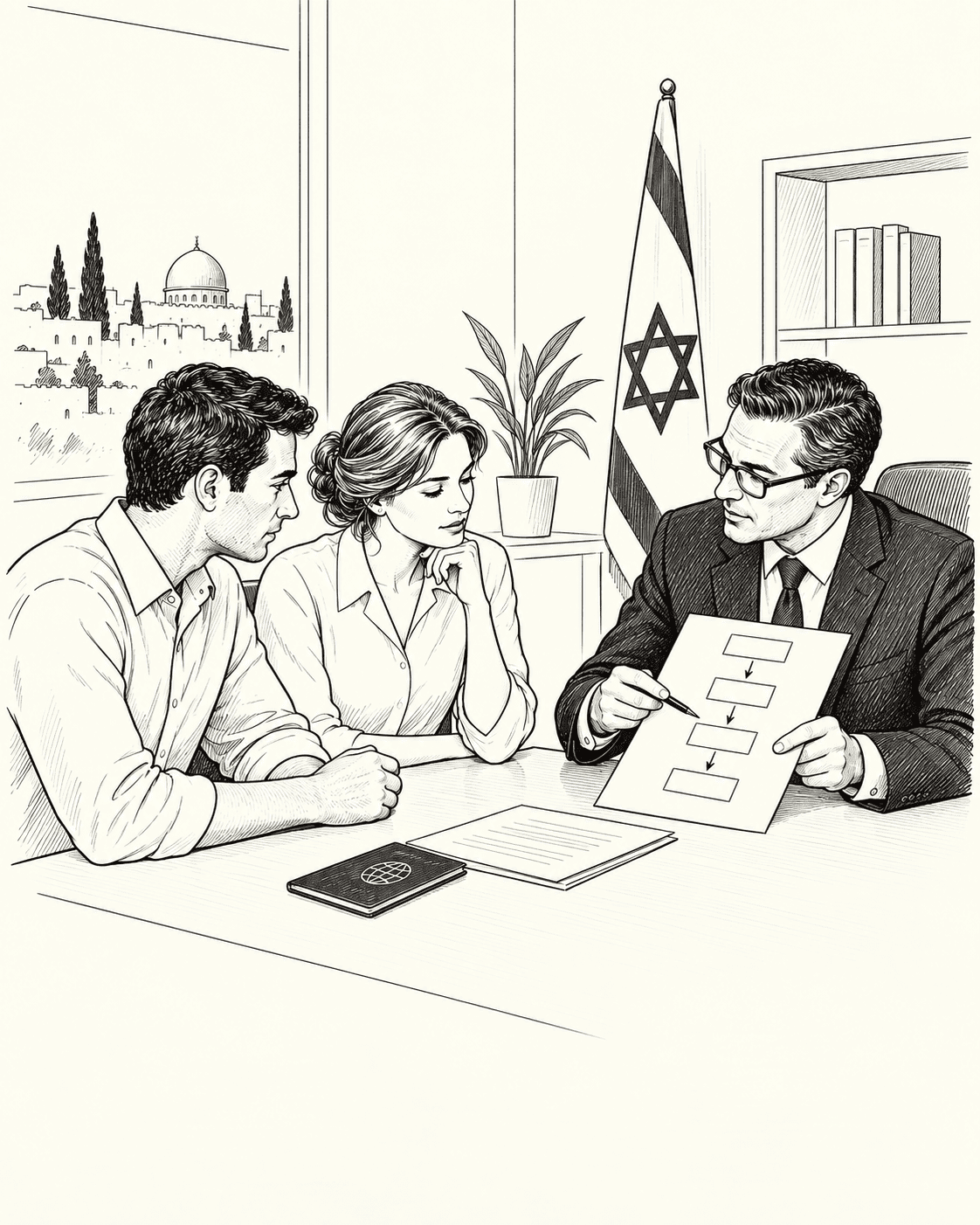 The exact sequence can vary depending on the specifics of the case, but the general outline is as follows.
Remote Document Submission
The document package is first uploaded remotely and submitted to the Ministry of Interior for review.
Request for Missing Documents
If anything is missing, the Ministry issues a request for additional documents — typically allowing around 45 days to respond.
First Meeting at the Ministry of Interior
After the initial review, the Israeli citizen is invited in for a meeting, where original documents, translations, and other materials previously submitted remotely must be presented.
Entry Permit for the Spouse
If the documents are accepted and no further issues surface, the Ministry approves the foreign spouse’s entry into Israel. At this stage, the person can relocate to join their spouse and enter the country.
Work Authorization
After arriving, the couple returns to the Ministry of Interior, where the foreign spouse is typically issued a work visa.
Additional Consular Steps
The process may also require contacting the consular department in Jerusalem, filling out a form, and waiting to be scheduled further.
Main Interview
The couple is then invited for a full interview at the Ministry of Interior. If it goes well, the foreign spouse receives their first temporary residence permit — A/5 status.
Annual Status Renewal
After obtaining A/5 status, the couple must continue reporting to the Ministry every year, confirming they’re still living together, submitting documents, and going through additional reviews. This stage typically lasts several years.
Completion of the Procedure
Once the temporary residency period is complete, one more interview is held. If everything checks out, the foreign spouse becomes eligible for Israeli citizenship.
How Long the Procedure Takes
In cases without major complications, the entire process — from the start of the procedure to citizenship — can take roughly five years.
The initial entry permit for the foreign spouse can be obtained much sooner. In a relatively straightforward case, this can take approximately three to four, or five to six, months.
If serious issues arise and a dispute with the Ministry develops, even the entry-permit stage alone can stretch out significantly — up to a year or longer. There is no single, fixed timeline that applies to every family.
How to Reduce the Risk of Delays
One of the leading causes of complications isn’t the family’s actual circumstances, but improperly prepared documents. If a required document is missing, an official may not be able to move the case forward even when the relationship is clearly genuine.
Document names and formats also vary from country to country. For instance, proof of prior marital status may be issued differently depending on the country, and in some places, the exact document an Israeli official expects may not even exist.
In such situations, it’s important not to simply argue with the Ministry, but to figure out exactly which document is needed and whether an equivalent exists. Constructive engagement with the system, combined with a well-prepared document package from the outset, significantly reduces the risk of unnecessary delays and additional scrutiny.
FAQ
Can status be granted based on a marriage certificate alone?
No. A marriage certificate is only one part of the process. The Ministry of Interior also reviews both spouses’ documents, their backgrounds, the Israeli citizen’s center of life, and whether the relationship is genuine.
Do the couple have to be formally married?
Not necessarily. Under certain circumstances, the procedure can also apply to couples in a common-law partnership.
What happens if the foreign spouse has gone through this procedure before?
A prior procedure will be taken into account when reviewing the new application and may lead to a more thorough review. However, that history alone doesn’t make a new application impossible.
Can past entry issues with Israel affect the case?
Yes. For example, a prior entry refusal, an asylum application, or another immigration status can raise additional questions from the Ministry of Interior.
How long does the family reunification procedure take?
In a relatively straightforward case, reaching citizenship takes about five years. Where there are disputed circumstances, individual stages can take considerably longer.
Is interview preparation necessary?
Yes. Both spouses need to know the real history of their relationship well and be able to describe it consistently. Especially thorough preparation is needed if an interview is scheduled simultaneously in Israel and abroad.
In Short
The family reunification procedure allows the foreign spouse of an Israeli citizen to legalize their residence in the country and gradually move toward a more permanent status.
What matters isn’t just the formal marriage — it’s also a properly prepared document package, a transparent relationship history, and consistency across all information provided. Past immigration procedures, entry refusals, prior relationships with Israeli citizens, or a complicated marital history don’t necessarily make the procedure impossible, but they can lead to additional scrutiny and longer timelines.
The better a case is prepared from the outset, the lower the risk that review will stall over a missing document or other formal issue.
Disclaimer: The requirements and practices of Israel’s Ministry of Interior may change. This material is for informational purposes and reflects the situation as of the publication date.


